
Liquor Licence Renewal Timeline in Victoria
What to do, when to do it, and what happens if you don’t
Renewing a liquor licence in Victoria is not a single deadline — it’s a staged regulatory timeline with escalating consequences if action isn’t taken.
While all liquor licence types share the same annual renewal cycle, many licence holders misunderstand what happens after 31 December, and when trading actually becomes unlawful.
This article sets out the full liquor licence renewal timeline in Victoria and explains what licensees should be doing at each stage.
Who manages liquor licence renewals?
Liquor licence renewals in Victoria are administered by Liquor Control Victoria (LCV).
Renewals are managed through the online Liquor Portal, and responsibility always sits with the licence holder. Reminder emails are typically issued, but failing to receive one does not remove your obligation to renew.
The liquor licence renewal timeline (Victoria)
All standard liquor licences in Victoria follow the same renewal pathway each year.
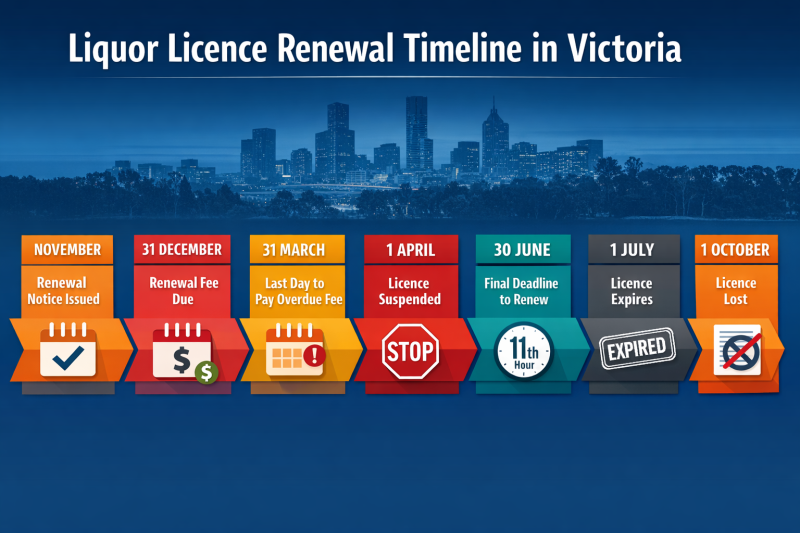
November — renewal opens
-
Renewal notice is issued
-
Notification is emailed to the licence holder
-
Renewal becomes available in the Liquor Portal
This is the ideal time to:
-
Confirm licence details are correct
-
Check contact email addresses
-
Identify whether any licence changes are needed
31 December — renewal fee due
-
Renewal fee must be paid by this date
-
Last day to apply for licence changes, including:
-
Trading hours
-
Maximum patron numbers
-
Floor area or layout changes
-
Prescribed venue type changes
-
This is the critical cutoff for variations. After this date, licence changes generally cannot be processed until the next renewal cycle.
31 March — final administrative grace period
-
Last day to pay an overdue renewal fee
-
Last day to apply for a fee reduction or fee waiver
Although the licence is not yet suspended, unresolved non-payment is now approaching enforcement territory.
1 April — licence suspended (“ceased in force”)
-
Licences and permits with unpaid renewal fees are suspended
-
You must stop supplying alcohol
-
Supplying alcohol from this date is illegal
This is the point many licensees misunderstand. You cannot continue trading while “sorting it out”.
30 June — final chance to save the licence
-
Last day to pay before the licence is lost
-
If unpaid after this date, the licence will expire
This is effectively the end of the road for the licence holder.
1 July — licence expires
-
Unpaid licences and permits expire
-
Only landlords, mortgagees, or other affected parties may apply to renew
At this stage, the original licence holder can no longer recover the licence.
30 September — last third-party recovery window
-
Final day for landlords, mortgagees, or affected parties to apply to renew an expired licence
1 October — licence permanently lost
-
Licence or permit cannot be renewed
-
If liquor service is required, a new licence application must be made
This means new fees, new assessments, and potentially months without the ability to trade.
Why this timeline matters
A common misconception is that missing 31 December simply attracts a small penalty.
In reality, the renewal process follows a strict legal pathway:
overdue → suspended → expired → unrecoverable
Once a licence is suspended or expired, trading becomes unlawful and business continuity can be seriously affected.
Key things licence holders should check before renewing
Before paying a renewal, it’s worth confirming that:
-
The licence reflects how the premises currently operates
-
Trading hours align with planning approvals
-
Patron numbers and floor areas are accurate
-
Any historic variations have been properly approved
Renewal is often the point where inconsistencies between planning and licensing come to light.
Need help with a liquor licence renewal?
Many renewals are straightforward. Others aren’t — particularly where venues have evolved over time, conditions are unclear, or planning approvals don’t align neatly with the licence.
Getting advice before renewal deadlines is far easier (and cheaper) than fixing issues after suspension or expiry.